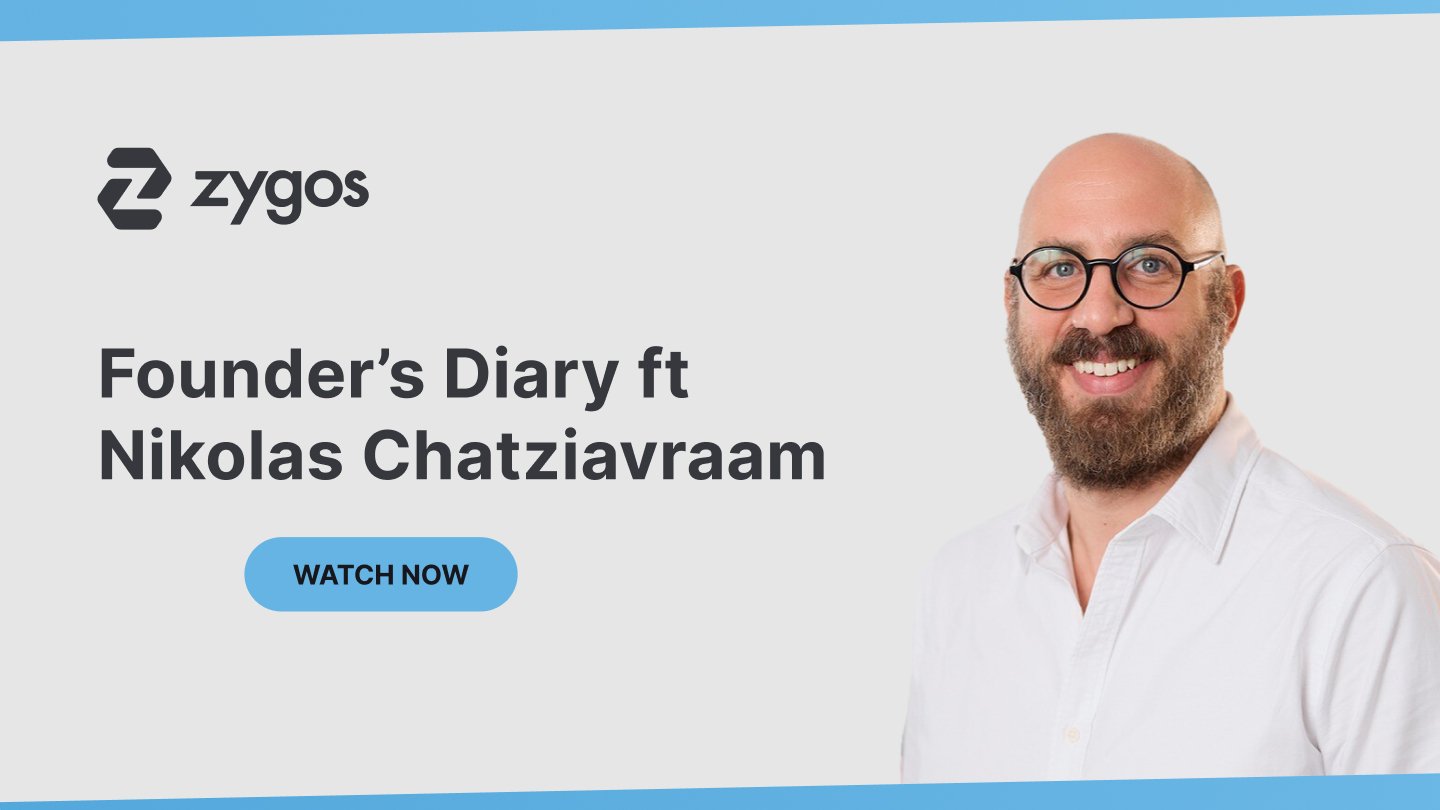
Founder’s Diary ft Nikolas Chatziavraam
On this episode of Founder’s Diary, Aventine Lab’s Arsalan Abbasi sat down with Nikolas Chatziavraam, CEO of Zygos, by the Hilton in Malta. Zygos is a practice management platform for lawyers, accountants and corporate service providers (CSPs). That week it held a private launch of its rebuilt platform, sponsored the Institute of Financial Services Practitioners (IFSP) annual conference, and sponsored the European Business Registries Association conference with its local partner.
The conversation covered the pressures on firms in service-heavy jurisdictions, the rise of shadow AI, the move from conversational to agentic AI for law firms, MCP as the new API, token-based pricing, and how Zygos rebuilt its platform to be AI-ready. Here are the key ideas.
What is keeping firms in service-heavy jurisdictions up at night
Zygos is based in Cyprus and serves what Nikolas calls service-heavy jurisdictions: Cyprus, Malta, Switzerland, Mauritius, the UAE, the Channel Islands, the Isle of Man, Cayman, Bermuda, Singapore and Hong Kong. Across all of them, the pain points sound almost the same:
- Constant uncertainty. Geopolitical instability, and the knock-on effects it has on clients, structures and deals.
- A growing compliance burden. A steady flow of heavy EU regulation that smaller firms struggle to absorb.
- AI without governance. Firms are adopting AI quickly, often without a framework.
- Regulatory reporting. Regulator visits are stricter and more demanding. Arsalan heard from the Maltese firms he spoke to that reporting season is a misery.
On reporting, Nikolas was blunt. In many firms, panic starts when the regulator announces a visit. The firms that handle it well treat inspection readiness as a process backed by a system that produces the required reports, not a scramble the week before.
Shadow AI: the AI adoption nobody reports
Nikolas pointed to a study on AI adoption in professional services. The most important finding was the adoption that goes unreported. Lawyers, accountants and CSPs are using ChatGPT, Gemini and Claude at their own discretion, with no firm framework around them. That is shadow AI, and it is risky because client data is being shared with tools the firm has not approved and cannot track.
Firms should implement internal governance frameworks now, as opposed to when their lawyers are already using it and the firm is behind its own lawyers. And it shouldn’t be restrictive. It should be reassuring.
Nikolas Chatziavraam, CEO, Zygos
His advice comes down to three moves:
- Do not deny it. Assume your people are already using AI and find out how.
- Set a framework now. Be clear about what is allowed, what is not, and how client data may be used. The legal adoption curve is steep, and the efficiency gains are too big to block outright.
- Give people a governed alternative. AI that runs on the firm’s own data, inside its own tenancy, removes the reason to go around the rules.
For more on how compliance teams are approaching AI, see our AI Due Diligence Workshop for Law Firms.
Conversational AI vs agentic AI: why 2026 is the year of the agent
Nikolas called 2026 the year of agentic AI. Six months in AI now feels like ten years, and there is a clear “pre-Claude and post-Claude” divide in how people work. The difference between a chat interface and an agent is not just the model. It is how the work is structured.
- Agents have a goal, lay out a plan and use tools to achieve it. Onboarding a client, for example, means reviewing documents, running screening and checking the results.
- The work can be audited. You can trace each decision an agent made, which matters a great deal in a regulated profession.
- There is a human in the loop. A person can review and sign off at the end of the agent’s process.
- Agents can be grounded in your data. They work from your single source of truth, and guardrails reduce hallucinations and common mistakes.
Arsalan described the end state as a set of virtual employees, each with defined tasks and limits. Nikolas expects people to orchestrate agents and review their output, and expects agents to review other agents. That already happens today.
Will agents replace paralegals and bookkeepers?
Nikolas does not think so. He compared it to the spreadsheet, which was supposed to replace accountants and instead made them far more productive. One bookkeeper will be able to do much more bookkeeping, with better accuracy, because an agent can spot discrepancies across many documents at once. With talent shortages across European firms, he expects demand for these roles to grow rather than shrink. What disappears is the low-value admin work.
SaaS is not dead: from systems of record to systems of action
“SaaS is dead” is a popular line at the moment. Nikolas disagrees. A good SaaS platform will evolve into a space for agents, using the large amounts of data clients already hold in it. The shift is from systems of record (where the data lives) to systems of action (where agents act on that data).
Context is what makes this work. A general model like Claude knows nothing about your matters. Practice management is effectively a data lake of clients, matters, entities, documents and bills. An agent grounded in that data is far more useful than one working from whatever you paste into a chat window.
MCP: the API of the agentic era
Nikolas described MCP (Model Context Protocol) as the equivalent of the API in the SaaS era. Every serious platform will need an MCP server so agents can work across systems. He gave a simple example of an agent workflow:
- Each morning an agent reviews your meetings through the Outlook MCP.
- It takes the attendees and checks the Zygos MCP for unpaid bills.
- It checks the HubSpot MCP for open opportunities.
- It delivers a morning report for your day.
Is MCP a data security risk? This is the question firms ask most. Nikolas’s answer was that an MCP connection works like an API request. Claude does not get into the Zygos database and search its tables. It asks Zygos for a specific record, such as an invoice or a company record, and Zygos returns it only if the user has permission. If you are comfortable with API integrations, the model is the same.
Arsalan made the wider point: vendors that refuse to integrate will lose. Some legacy providers stick to closed partner ecosystems, but customers run varied tech stacks. If vendors do not connect, customers will connect them through MCP themselves. Nikolas agreed. People do not log into one system and finish their work. They use a calendar, tasks, a CRM and more, so an agent needs context from many sources.
The legal tech stack a smaller firm actually needs
For a typical general law firm, accountancy practice or CSP, Nikolas said three systems are enough: a CRM for the pipeline before someone becomes a client, practice management for the work itself, and accounting (Sage, Xero and similar) afterwards. Specialist firms in areas such as IP or conveyancing will add specialist tools.
Token costs, pricing and who pays for AI
Running agents costs tokens, and those costs grow with use. Nikolas expects SaaS pricing to move towards volume or credit-based pricing, because that is the only way vendors can control consumption and cost. Zygos uses a hybrid model of seat-based pricing plus volume.
Can firms pass token costs on to clients as a disbursement? Nikolas thinks not. Clients now expect law firms to use AI. Token costs should be built into the engagement and pricing, the same way staff costs are, rather than added to the bill as a line item.
Inside Athena: the AI agent built into Zygos
Zygos serves around 400 firms worldwide across law, accounting and corporate services. The platform covers onboarding, screening, monitoring and risk assessment, plus deep entity administration (share capital, UBO tracing, registers and registrar forms), project and task management, billing and documents. It started life serving litigation lawyers, so it also handles court cases, deadlines, workflows with automatic reminders, calendars and hearings.
Athena is the AI layer built on top of all of that. Firms use it to:
- Help with client onboarding.
- Research documents, directorships, secretaries, loan agreements and specimens held in the platform.
- Review judgments and court decisions, producing arguments, summaries and timelines.
- Answer questions about a matter, such as who last communicated with the client or what the next step is.
- Run research questions for reporting, such as a breakdown of clients by jurisdiction and where the risk sits.
- Through the Zygos MCP, pull unbilled work and generate an invoice from inside Claude.
Three design decisions stand out:
- Private by design. Athena is a custom agent rather than a direct API call to one of the big AI labs, so client data does not spill over to them. Everything runs on AWS in an isolated tenancy.
- Grounded with references. Athena answers from the firm’s own data and always links back to the source document, so users can click through and verify.
- Guardrails. Ask it for a chicken recipe and it will refuse. It stays inside its job.
Your AI is as good as your data is.
Nikolas Chatziavraam
Why Zygos rebuilt its platform
After almost ten years of adding functionality, the platform had become clunky. Zygos chose to rethink how it delivers data to clients, not just reskin the interface. It built its own design system and components, then rebuilt the interfaces on top so that AI could be used naturally within them. The new platform was scheduled to launch in Cyprus on 9 June, with existing clients migrating and new clients onboarding from around September.
Tools are only as good as the processes around them
Asked whether Zygos prefers tech-savvy firms or firms starting from scratch, Nikolas said neither matters much. What matters is appetite and process. He has seen implementations fail because the firm did not have the right processes or internal champions. A tool needs training, process design and management support behind it. A tool is just a tool, but used well it delivers large efficiencies.
The changing economics of law
The biggest pain point Nikolas hears is a change in how value is delivered to clients. Clients are more demanding and less willing to accept the billable hour without question. Arsalan pointed to Revolut, which reportedly measures its law firm panel on KPIs such as time to deliver, cost and use of AI. Paralegal-level work may increasingly move in-house, with clients going to lawyers for complex matters and final review, much as small businesses do their own books and pay an accountant to check them.
Nikolas also sees the big AI labs moving into legal and financial services as a sign of what is coming. Whoever controls the layer that sits on top of every tool becomes very powerful, just as the browser did when software moved to the cloud. Vendors need to be ready for that kind of vertical, full-stack competition.
What’s next for Zygos
Zygos’s priorities are becoming an AI-first practice management platform by rethinking its processes in an agentic way, and expanding across service-heavy offshore and mid-shore jurisdictions. Nikolas called it “a niche within a niche”. Those jurisdictions face more intense regulation, especially on AML and entity administration. That makes a platform built for them a strong fit for firms in less demanding jurisdictions too.
Key takeaways
- Shadow AI is already happening in your firm. Put a governance framework in place now, and make it reassuring rather than restrictive.
- Agentic AI is different from chatbots: it is goal-driven, uses tools, can be audited, and keeps a human in the loop.
- MCP is becoming the API of the agentic era. Choose vendors that are open to connecting with the rest of your stack.
- AI is only as good as the data and context behind it. Practice management systems are well placed to provide that context.
- Expect pricing to shift towards volume and credit models. Token costs belong in your pricing, not in disbursements.
Explore more: read the Zygos vendor profile, watch our Founder’s Diary with Forsyte, or see the Best AML Tools for Law Firms 2026.